COURTESY : INVESTOPEDIA
In the late 1990s, when technology companies were flourishing, growth investing techniques yielded unprecedented returns for investors. But before any investor jumps onto the growth investing bandwagon, s/he should realize that this strategy comes with substantial risks and is not for everyone.
Value versus Growth
The best way to define growth investing is to contrast it to value investing. Value investors are strictly concerned with the here and now; they look for stocks that, at this moment, are trading for less than their apparent worth. Growth investors, on the other hand, focus on the future potential of a company, with much less emphasis on its present price. Unlike value investors, growth investors buy companies that are trading higher than their current intrinsic worth - but this is done with the belief that the companies' intrinsic worth will grow and therefore exceed their current valuations.
As the name suggests, growth stocks are companies that grow substantially faster than others. Growth investors are therefore primarily concerned with young companies. The theory is that growth in earnings and/or revenues will directly translate into an increase in the stock price. Typically a growth investor looks for investments in rapidly expanding industries especially those related to new technology. Profits are realized through capital gains and not dividends as nearly all growth companies reinvest their earnings and do not pay a dividend.
No Automatic Formula
Growth investors are concerned with a company's future growth potential, but there is no absolute formula for evaluating this potential. Every method of picking growth stocks (or any other type of stock) requires some individual interpretation and judgment. Growth investors use certain methods - or sets of guidelines or criteria - as a framework for their analysis, but these methods must be applied with a company's particular situation in mind. More specifically, the investor must consider the company in relation to its past performance and its industry's performance. The application of any one guideline or criterion may therefore change from company to company and from industry to industry.
The NAIC
The National Association of Investors Corporation (NAIC) is one of the best known organizations using and teaching the growth investing strategy. It is, as it says on its website, "one big investment club" whose goal is to teach investors how to invest wisely. The NAIC has developed some basic "universal" guidelines for finding possible growth companies - here's a look at some of the questions the NAIC suggests you should ask when considering stocks.
1. Strong Historical Earnings Growth?
According to the NAIC, the first question a growth investor should ask is whether the company, based on annual revenue, has been growing in the past. Below are rough guidelines for the rate of EPS growth an investor should look for in companies of differing sizes, which would indicate their growth investing potential:
Although the NAIC suggests that companies display this type of EPS growth in at least the last five years, a 10-year period of this growth is even more attractive. The basic idea is that if a company has displayed good growth (as defined by the above chart) over the last five- or 10-year period, it is likely to continue doing so in the next five to 10 years.
2. Strong Forward Earnings Growth?
The second criterion set out by the NAIC is a projected five-year growth rate of at least 10-12%, although 15% or more is ideal. These projections are made by analysts, the company or other credible sources.
The big problem with forward estimates is that they are estimates. When a growth investor sees an ideal growth projection, he or she, before trusting this projection, must evaluate its credibility. This requires knowledge of the typical growth rates for different sizes of companies. For example, an established large cap will not be able to grow as quickly as a younger small-cap tech company. Also, when evaluating analyst consensus estimates, an investor should learn about the company's industry - specifically, what its prospects are and what stage of growth it is at. (See The Stages of Industry Growth.)
3. Is Management Controlling Costs and Revenues?
The third guideline set out by the NAIC focuses specifically on pre-tax profit margins. There are many examples of companies with astounding growth in sales but less than outstanding gains in earnings. High annual revenue growth is good, but if EPS has not increased proportionately, it's likely due to a decrease in profit margin.
By comparing a company's present profit margins to its past margins and its competition's profit margins, a growth investor is able to gauge fairly accurately whether or not management is controlling costs and revenues and maintaining margins. A good rule of thumb is that if company exceeds its previous five-year average of pre-tax profit margins as well as those of its industry, the company may be a good growth candidate.
4. Can Management Operate the Business Efficiently?
Efficiency can be quantified by using return on equity (ROE). Efficient use of assets should be reflected in a stable or increasing ROE. Again, analysis of this metric should be relative: a company's present ROE is best compared to the five-year average ROE of the company and the industry.
5. Can the Stock Price Double in Five Years?
If a stock cannot realistically double in five years, it's probably not a growth stock. That's the general consensus. This may seem like an overly high, unrealistic standard, but remember that with a growth rate of 10%, a stock's price would double in seven years. So the rate growth investors are seeking is 15% per annum, which yields a doubling in price in five years.
An Example
Now that we've outlined the NAIC's basic criteria for evaluating growth stocks, let's demonstrate how these criteria are used to analyze a company, using Microsoft's 2003 figures. For the sake of this demonstration, we'll discuss these numbers as though they were Microsoft's most current figures (that is, "today's figures").
1. Five-Year Earnings Figures
Both of these are strong figures. The annual EPS growth is well above the 5% standard the NAIC sets out for firms of Microsoft's size.
2. Strong Projected Earnings Growth
The projected growth figures are strong, but not exceptional.
3. Costs and Revenue Control
There are two ways to look at this. The trend is down 5.08% (50.88% - 45.80%) from the five-year average, which is negative. But notice that the industry's average margin is only 26.7%. So even though Microsoft's margins have dropped, they're still a great deal higher than those of its industry.
4. ROE
Again, it's a point of concern that the ROE figure is a little lower than the five-year average. However, like Microsoft's profit margin, the ROE is not drastically reduced - it's only down a few points and still well above the industry average.
5. Potential to Double in Five Years
The average analyst projections for Microsoft suggest that in five years the stock will not merely double in value, but it'll be worth 254.7% its current value.
Is Microsoft a Growth Stock? On paper, Microsoft meets many NAIC's criteria for a growth stock. But it also falls short of others. If, for instance, we were to dismiss Microsoft because of its decreased margins and not compare them to the industry's margins, we would be ignoring the industry conditions within which Microsoft functions. On the other hand, when comparing Microsoft to its industry, we must still decide how telling it is that Microsoft has higher-than-average margins. Is Microsoft a good growth stock even though its industry may be maturing and facing declining margins? Can a company of its size find enough new markets to keep expanding?
Clearly there are arguments on both sides and there is no "right" answer. What these criteria do, however, is open up doorways of analysis through which we can dig deeper into a company's condition. Because no single set of criteria is infallible, the growth investor may want to adjust a set of guidelines by adding (or omitting) criteria. So, although we've provided five basic questions, it's important to note that the purpose of the example is to provide a starting point from which you can build your own growth screens.
Conclusion
It's not too complicated: growth investors are concerned with growth. The guiding principle of growth investing is to look for companies that keep reinvesting into themselves to produce new products and technology. Even though the stocks might be expensive in the present, growth investors believe that expanding top and bottom lines will ensure an investment pays off in the long run.
The best way to define growth investing is to contrast it to value investing. Value investors are strictly concerned with the here and now; they look for stocks that, at this moment, are trading for less than their apparent worth. Growth investors, on the other hand, focus on the future potential of a company, with much less emphasis on its present price. Unlike value investors, growth investors buy companies that are trading higher than their current intrinsic worth - but this is done with the belief that the companies' intrinsic worth will grow and therefore exceed their current valuations.
As the name suggests, growth stocks are companies that grow substantially faster than others. Growth investors are therefore primarily concerned with young companies. The theory is that growth in earnings and/or revenues will directly translate into an increase in the stock price. Typically a growth investor looks for investments in rapidly expanding industries especially those related to new technology. Profits are realized through capital gains and not dividends as nearly all growth companies reinvest their earnings and do not pay a dividend.
No Automatic Formula
Growth investors are concerned with a company's future growth potential, but there is no absolute formula for evaluating this potential. Every method of picking growth stocks (or any other type of stock) requires some individual interpretation and judgment. Growth investors use certain methods - or sets of guidelines or criteria - as a framework for their analysis, but these methods must be applied with a company's particular situation in mind. More specifically, the investor must consider the company in relation to its past performance and its industry's performance. The application of any one guideline or criterion may therefore change from company to company and from industry to industry.
The NAIC
The National Association of Investors Corporation (NAIC) is one of the best known organizations using and teaching the growth investing strategy. It is, as it says on its website, "one big investment club" whose goal is to teach investors how to invest wisely. The NAIC has developed some basic "universal" guidelines for finding possible growth companies - here's a look at some of the questions the NAIC suggests you should ask when considering stocks.
1. Strong Historical Earnings Growth?
According to the NAIC, the first question a growth investor should ask is whether the company, based on annual revenue, has been growing in the past. Below are rough guidelines for the rate of EPS growth an investor should look for in companies of differing sizes, which would indicate their growth investing potential:
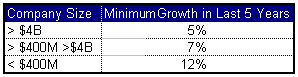 |
Although the NAIC suggests that companies display this type of EPS growth in at least the last five years, a 10-year period of this growth is even more attractive. The basic idea is that if a company has displayed good growth (as defined by the above chart) over the last five- or 10-year period, it is likely to continue doing so in the next five to 10 years.
2. Strong Forward Earnings Growth?
The second criterion set out by the NAIC is a projected five-year growth rate of at least 10-12%, although 15% or more is ideal. These projections are made by analysts, the company or other credible sources.
The big problem with forward estimates is that they are estimates. When a growth investor sees an ideal growth projection, he or she, before trusting this projection, must evaluate its credibility. This requires knowledge of the typical growth rates for different sizes of companies. For example, an established large cap will not be able to grow as quickly as a younger small-cap tech company. Also, when evaluating analyst consensus estimates, an investor should learn about the company's industry - specifically, what its prospects are and what stage of growth it is at. (See The Stages of Industry Growth.)
3. Is Management Controlling Costs and Revenues?
The third guideline set out by the NAIC focuses specifically on pre-tax profit margins. There are many examples of companies with astounding growth in sales but less than outstanding gains in earnings. High annual revenue growth is good, but if EPS has not increased proportionately, it's likely due to a decrease in profit margin.
By comparing a company's present profit margins to its past margins and its competition's profit margins, a growth investor is able to gauge fairly accurately whether or not management is controlling costs and revenues and maintaining margins. A good rule of thumb is that if company exceeds its previous five-year average of pre-tax profit margins as well as those of its industry, the company may be a good growth candidate.
4. Can Management Operate the Business Efficiently?
Efficiency can be quantified by using return on equity (ROE). Efficient use of assets should be reflected in a stable or increasing ROE. Again, analysis of this metric should be relative: a company's present ROE is best compared to the five-year average ROE of the company and the industry.
5. Can the Stock Price Double in Five Years?
If a stock cannot realistically double in five years, it's probably not a growth stock. That's the general consensus. This may seem like an overly high, unrealistic standard, but remember that with a growth rate of 10%, a stock's price would double in seven years. So the rate growth investors are seeking is 15% per annum, which yields a doubling in price in five years.
An Example
Now that we've outlined the NAIC's basic criteria for evaluating growth stocks, let's demonstrate how these criteria are used to analyze a company, using Microsoft's 2003 figures. For the sake of this demonstration, we'll discuss these numbers as though they were Microsoft's most current figures (that is, "today's figures").
1. Five-Year Earnings Figures
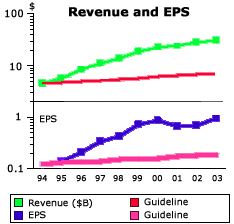 • Five-year average annual sales growth is 15.94%. • Five-year average annual EPS growth is 10.91%. |
Both of these are strong figures. The annual EPS growth is well above the 5% standard the NAIC sets out for firms of Microsoft's size.
2. Strong Projected Earnings Growth
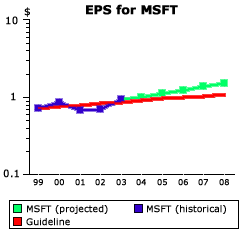 • Five-year projected average annual earnings growth is 11.03%. |
The projected growth figures are strong, but not exceptional.
3. Costs and Revenue Control
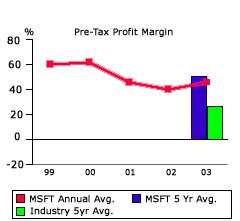 • Pre-tax margin in most recent fiscal year is 45.80%. • Five-year average fiscal pre-tax margin is 50.88%. • Industry's five-year average pre-tax margin is 26.7%. |
There are two ways to look at this. The trend is down 5.08% (50.88% - 45.80%) from the five-year average, which is negative. But notice that the industry's average margin is only 26.7%. So even though Microsoft's margins have dropped, they're still a great deal higher than those of its industry.
4. ROE
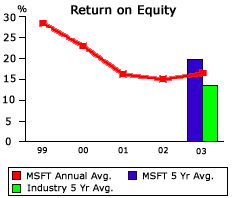 • Most recent fiscal year-end is ROE 16.40%. • Five-year average ROE is 19.80%. • Industry average five-year ROE is 13.60%. |
Again, it's a point of concern that the ROE figure is a little lower than the five-year average. However, like Microsoft's profit margin, the ROE is not drastically reduced - it's only down a few points and still well above the industry average.
5. Potential to Double in Five Years
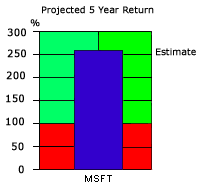 • Stock is projected to appreciate by 254.7%. |
The average analyst projections for Microsoft suggest that in five years the stock will not merely double in value, but it'll be worth 254.7% its current value.
Is Microsoft a Growth Stock? On paper, Microsoft meets many NAIC's criteria for a growth stock. But it also falls short of others. If, for instance, we were to dismiss Microsoft because of its decreased margins and not compare them to the industry's margins, we would be ignoring the industry conditions within which Microsoft functions. On the other hand, when comparing Microsoft to its industry, we must still decide how telling it is that Microsoft has higher-than-average margins. Is Microsoft a good growth stock even though its industry may be maturing and facing declining margins? Can a company of its size find enough new markets to keep expanding?
Clearly there are arguments on both sides and there is no "right" answer. What these criteria do, however, is open up doorways of analysis through which we can dig deeper into a company's condition. Because no single set of criteria is infallible, the growth investor may want to adjust a set of guidelines by adding (or omitting) criteria. So, although we've provided five basic questions, it's important to note that the purpose of the example is to provide a starting point from which you can build your own growth screens.
Conclusion
It's not too complicated: growth investors are concerned with growth. The guiding principle of growth investing is to look for companies that keep reinvesting into themselves to produce new products and technology. Even though the stocks might be expensive in the present, growth investors believe that expanding top and bottom lines will ensure an investment pays off in the long run.

